Epiglottis & Supraglottic Airway
Epiglottitis
Epiglottitis is a rapidly progressive inflammation of the epiglottis and adjacent supraglottic structures that can cause life-threatening upper-airway obstruction.
Clinical Vignette
A child who refuses to lie down
Recognize the airway emergency before reaching for a test.
A 3-year-old boy is brought to the emergency department for abrupt onset of high fever, severe sore throat, and refusal to drink. His parents report that over the past several hours he has become progressively less willing to speak or swallow.
He has had very little cough and no significant rhinorrhea. His immunizations are not up to date.
Temperature is 39.4°C/102.9°F. He sits upright on his caregiver's lap, leaning forward with his neck extended. He is drooling rather than swallowing his secretions, and his voice is quiet and muffled. Inspiratory stridor is beginning to develop.
When someone attempts to reposition him for examination, he becomes visibly more distressed and immediately returns to his preferred upright position.
Your first clinical task
What diagnosis should immediately concern you, and what routine examination or testing steps could make this child less safe?
Anatomy & Localization
Epiglottitis is a supraglottic airway disease
The level of inflammation explains the drooling, muffled voice, dysphagia, and rapid risk of airway obstruction.
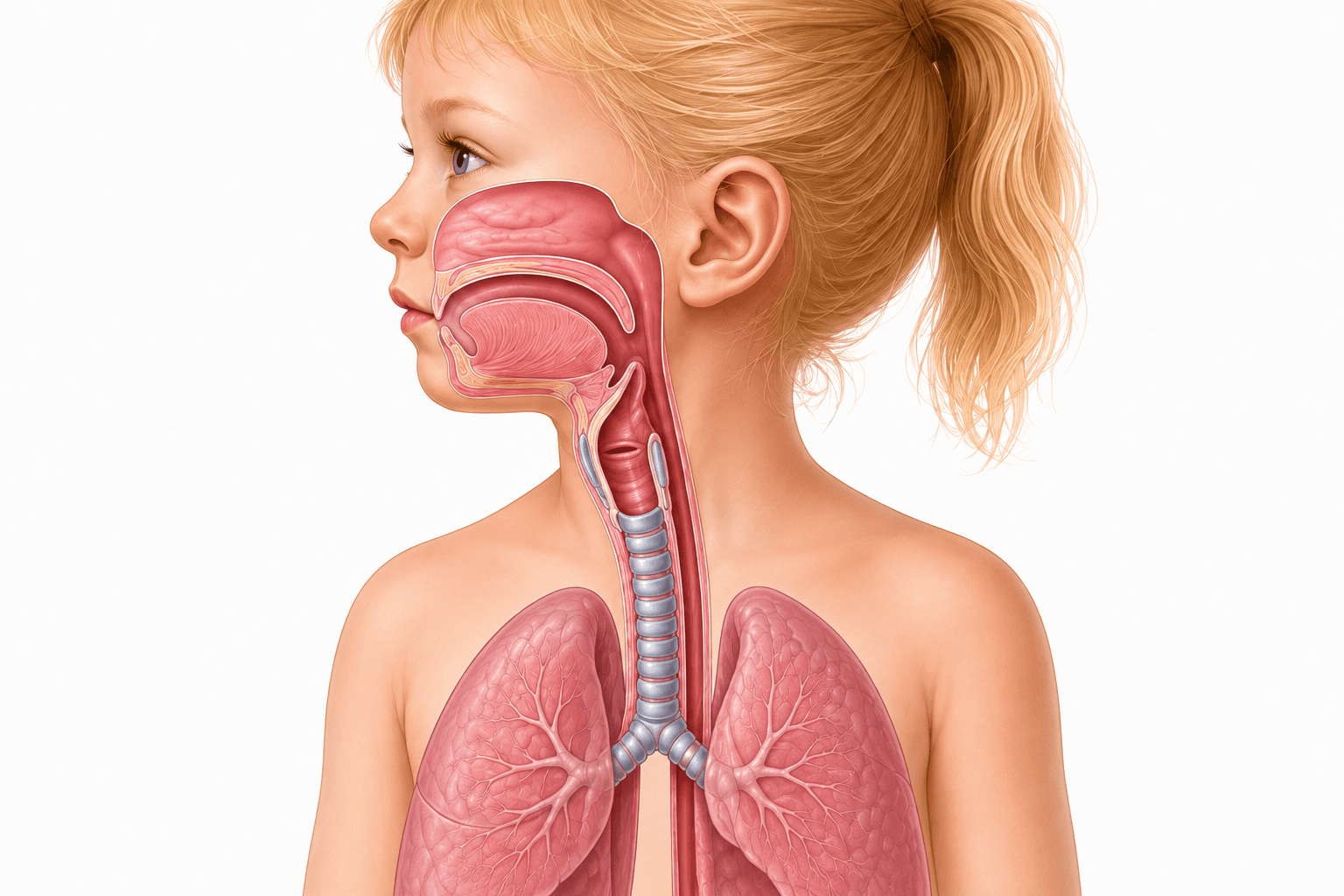
Epiglottis
Leaf-shaped cartilage at the laryngeal inlet that helps protect the airway during swallowing.
Supraglottic airway
Region above the vocal cords that includes the epiglottis and adjacent laryngeal structures. Inflammation here can impair swallowing and threaten the airway.
Epiglottis & supraglottic airway
Epiglottitis primarily affects the epiglottis and adjacent supraglottic structures above the vocal cords. Inflammation and edema in this region can narrow the upper airway and interfere with swallowing and secretion handling.
Subglottic airway
The subglottic airway lies below the vocal cords and is the classic site of narrowing in croup. Disease at this level more commonly produces a barking cough, hoarseness, and inspiratory stridor without the prominent dysphagia and drooling seen in supraglottic disease.
Drooling
Painful swallowing and supraglottic inflammation can make the child unwilling or unable to handle oral secretions.
Muffled voice
Swelling above the vocal cords alters upper-airway resonance and can produce the classic muffled or "hot potato" quality.
Tripod positioning
Children may sit upright, lean forward, and extend the neck in an attempt to maximize airway patency and reduce obstruction.
Localization Check
Supraglottic vs subglottic obstruction
Croup and epiglottitis can both cause stridor, but the associated symptoms help localize the obstruction. Barking cough and hoarseness point toward the laryngeal/subglottic airway, whereas severe sore throat, dysphagia, drooling, and muffled voice suggest supraglottic disease.
Pathophysiology
Supraglottic inflammation can rapidly become a mechanical airway problem
Follow the progression from infection to edema, obstruction, and positional compensation.
Supraglottic infection
Bacterial infection involves the epiglottis and adjacent supraglottic tissues. Historically, Haemophilus influenzae type b was the dominant pediatric cause. However, in the Hib vaccine era, other bacterial pathogens account for a greater proportion of cases.
Rapid inflammatory edema
Inflammation causes marked swelling of the epiglottis and nearby supraglottic structures, narrowing the entrance to the laryngeal airway.
Progressive obstruction
As edema increases, airflow through the upper airway becomes increasingly restricted. Stridor, retractions, hypoxemia, and respiratory distress may develop as obstruction worsens.
Positional compensation
Children may sit upright, lean forward, and extend the neck to improve airway patency and reduce posterior displacement of the swollen epiglottis.
Why position matters
The tripod position is a physiologic adaptation
Children with significant supraglottic obstruction may instinctively sit upright, lean forward, and extend the neck while attempting to maximize airflow. A child who strongly prefers this position should be allowed to remain there rather than being forced supine for examination.
Airway Safety
Agitation can convert a tenuous airway into a critical airway
A child with significant supraglottic edema may be maintaining airway patency through position and respiratory effort. Forced examination, painful procedures, or unnecessary repositioning can increase distress and airflow demand while reducing the child's ability to maintain a position of comfort.
The Hib vaccine changed the disease
Before widespread Hib conjugate vaccination, epiglottitis was strongly associated with invasive Haemophilus influenzae type b disease in young children. Vaccination has dramatically reduced invasive Hib disease and shifted pediatric epiglottitis toward a much rarer condition with a broader range of potential bacterial causes (Streptococcus pneumoniae, Group A Streptococcus, and Staphylococcus aureus).
History & Physical
The bedside presentation should trigger concern before testing begins
Epiglottitis classically progresses rapidly, with prominent swallowing difficulty and signs of upper-airway obstruction.
Classic history
- • Abrupt onset and rapid progression over hours
- • High fever
- • Severe sore throat
- • Dysphagia or odynophagia
- • Refusal to eat or drink
- • Drooling or inability to handle secretions
- • Muffled or quiet voice
- • Little or no cough compared with croup
Physical examination
- • Anxious or ill-appearing child
- • Drooling
- • Muffled voice
- • Inspiratory stridor as obstruction progresses
- • Upright or tripod positioning
- • Neck extension
- • Retractions and increased work of breathing
- • Cyanosis or altered mental status in advanced obstruction
Classic Pattern
Remember the 3 Ds — but look at the whole child
Drooling
Difficulty handling secretions because swallowing is painful or impaired.
Dysphagia
Severe supraglottic inflammation makes swallowing difficult and painful.
Distress
Progressive airway narrowing can produce anxiety, stridor, retractions, and respiratory distress.
Bedside Clue
A child who refuses to lie down is telling you something
A child who insists on sitting upright, leaning forward, or extending the neck may be actively maintaining airway patency. Do not force the child supine simply to complete a routine examination.
Do Not Miss
Do not force an oropharyngeal examination in a child with suspected epiglottitis
Avoid using a tongue depressor or otherwise forcing visualization of the pharynx in a child with significant concern for epiglottitis. Agitation and airway manipulation can worsen obstruction. Keep the child calm and prioritize airway planning with experienced clinicians.
Differential Diagnosis
What else can cause acute upper-airway obstruction?
Stridor localizes the obstruction but does not identify the cause. The tempo of illness, swallowing difficulty, cough, fever, and associated findings help distinguish epiglottitis from other upper-airway emergencies.
Croup
Usually preceded by rhinorrhea and URI symptoms with a barking cough and hoarseness. Fever is often lower, drooling is unusual, and the child generally does not appear toxic.
Bacterial tracheitis
High fever, toxic appearance, stridor, rapidly progressive obstruction, and thick or purulent airway secretions. A barking cough may occur, and response to typical croup therapy is often poor.
Retropharyngeal / deep-neck infection
Fever, neck pain or stiffness, limited neck movement, dysphagia, drooling, muffled voice, or visible neck swelling. Stridor may occur if swelling significantly compromises the airway.
Foreign body
Abrupt onset after choking or eating, usually without fever or a preceding infectious illness. Findings depend on the location and degree of airway obstruction.
Anaphylaxis / angioedema
Sudden airway symptoms with lip or tongue swelling, urticaria, gastrointestinal symptoms, hypotension, or a recent allergen exposure. Fever and a progressive infectious prodrome are generally absent.
Croup vs Epiglottitis
The cough and the swallow are powerful clues
Think croup
- • Viral URI prodrome
- • Barking cough
- • Hoarseness
- • Stridor
- • Usually handles secretions
Think epiglottitis
- • Rapid progression
- • High fever
- • Severe sore throat
- • Dysphagia and drooling
- • Muffled voice
- • Tripod positioning
- • Barking cough typically absent
Diagnostic Red Flag
Drooling + stridor should change your approach
Prominent drooling or difficulty handling secretions in a child with stridor is not typical uncomplicated croup. Consider epiglottitis, deep-neck infection, foreign body, or another serious upper-airway process before performing potentially agitating examinations or procedures.
Diagnostic Workup
Airway stability determines the diagnostic approach
When epiglottitis is suspected, confirming the diagnosis must never take priority over maintaining a safe airway.
First Principle
Do not destabilize the child to obtain a diagnosis
Keep the child calm and allow them to remain in their preferred position. Avoid unnecessary IV placement, blood draws, forced oropharyngeal examination, or transport for imaging when significant airway compromise is suspected.
Assess airway stability
Evaluate position, work of breathing, stridor, secretion handling, oxygenation, air entry, and mental status while disturbing the child as little as possible.
Decide whether testing is safe
A stable child may undergo limited diagnostic evaluation when the diagnosis remains uncertain. A child with significant or progressive obstruction should not be sent away from an airway-capable setting simply to obtain testing.
Coordinate definitive evaluation
When airway intervention is required, direct visualization of the swollen epiglottis can confirm the diagnosis while the airway is secured in a controlled setting with experienced clinicians.
Stable child
- • Maintain close airway observation
- • Minimize agitation throughout the evaluation
- • Consider lateral neck radiography if the diagnosis is uncertain
- • Obtain laboratory studies only when they can be performed safely
- • Continue reassessing for clinical deterioration
Unstable or rapidly worsening child
- • Prioritize airway management over diagnostic testing
- • Do not delay airway planning for radiographs
- • Avoid forced examination of the oropharynx
- • Minimize procedures that provoke crying or agitation
- • Involve experienced airway clinicians immediately
Imaging Pearl
The thumb sign can support the diagnosis
When lateral neck radiography can be obtained safely, marked swelling of the epiglottis may produce the classic . Imaging is supportive rather than a prerequisite for treatment and should not delay airway management in a child with significant obstruction.
Laboratory & microbiologic evaluation
Blood cultures may help identify the causative organism, particularly when bacteremia is present. Additional laboratory testing should be obtained only when it can be performed without compromising airway safety.
If the airway is secured, cultures from the epiglottic surface may be obtained during controlled visualization when clinically appropriate. Diagnostic sampling should not precede stabilization of a threatened airway.
Direct Visualization
Seeing the epiglottis is not worth losing the airway
A swollen, erythematous epiglottis can establish the diagnosis during direct visualization, but examination of a threatened pediatric airway should occur only in a controlled setting where definitive airway management can be performed immediately.
Management
Protect the airway first, then treat the infection
Suspected epiglottitis requires a calm environment, early airway planning, and prompt antimicrobial therapy without allowing routine interventions to destabilize the child.
Keep the child calm
Allow the child to remain upright with a caregiver in their preferred position. Avoid unnecessary examination, painful procedures, or forced repositioning.
Mobilize airway expertise
Early involvement of experienced pediatric airway clinicians is essential when significant obstruction is suspected. Anesthesia, critical care, and ENT support may be required.
Secure a threatened airway
Progressive obstruction or significant respiratory compromise requires definitive airway management in a controlled setting with personnel and equipment prepared for a difficult airway.
Treat the infection
Begin parenteral antimicrobial therapy directed against likely bacterial pathogens once immediate airway safety has been addressed.
First Priority
The safest initial intervention may be doing less
Do not force the child to lie down, separate them unnecessarily from a caregiver, or perform a routine throat examination. A child maintaining airway patency through position and respiratory effort can deteriorate rapidly when frightened or agitated.
When airway intervention is needed
Airway management should be strongly considered when there is evidence of significant or progressive obstruction rather than waiting for respiratory collapse.
- • Increasing respiratory distress or work of breathing
- • Progressive or severe stridor
- • Inability to handle secretions
- • Hypoxemia or cyanosis
- • Decreasing air entry
- • Fatigue or altered mental status
- • Rapid clinical deterioration
Airway Planning
A controlled airway is safer than a crash airway
When definitive airway management is required, it should ideally occur in a controlled environment with clinicians experienced in pediatric airway management and immediate access to rescue airway techniques. Preparation should account for the possibility that severe supraglottic edema may make intubation difficult.
Empiric antimicrobial therapy
Epiglottitis is treated with parenteral antibiotics that provide coverage for likely invasive bacterial pathogens. A third-generation cephalosporin such as ceftriaxone or cefotaxime is a common foundation of therapy.
Additional antistaphylococcal coverage, including MRSA coverage when clinically appropriate, may be added based on illness severity, local epidemiology, microbiologic data, and institutional guidance.
Once culture and susceptibility results are available, antimicrobial therapy should be narrowed to the identified pathogen when possible.
Hib
Think beyond the individual patient when Hib is identified
Confirmed invasive Haemophilus influenzae type b disease has public-health implications in addition to treatment of the child. Vaccination status should be reviewed, and appropriate infection-control and contact prophylaxis recommendations should be addressed according to current public-health guidance.
Supportive care
- • Continuous cardiorespiratory and airway observation
- • Supplemental oxygen when needed and tolerated
- • IV fluids after vascular access can be obtained safely
- • Antipyretics and analgesia when appropriate
- • Frequent reassessment for progression of obstruction
Avoid unnecessary interventions
- • Forced throat examination
- • Unnecessary separation from the caregiver
- • Forcing the child into a supine position
- • Delaying airway management for diagnostic testing
- • Procedures that provoke agitation without changing immediate care
Disposition / Care Setting
Suspected pediatric epiglottitis belongs in an airway-capable hospital
Disposition is driven by the risk of rapid upper-airway deterioration, not simply by the child's appearance at a single moment.
PICU / airway-capable setting
Appropriate for children with significant or progressive airway compromise.
- • Stridor with increasing respiratory distress
- • Progressive inability to handle secretions
- • Hypoxemia or cyanosis
- • Decreasing air entry
- • Fatigue or altered mental status
- • Rapid clinical deterioration
- • Definitive airway already secured
Closely monitored inpatient observation
Selected clinically stable patients may not immediately require intubation but still require close airway observation.
- • Maintaining airway patency without progressive distress
- • Stable oxygenation and ventilation
- • No evidence of rapidly worsening obstruction
- • Immediate access to experienced airway clinicians
- • Ability to escalate rapidly if the clinical course changes
Step-down & discharge readiness
Discharge comes only after the acute airway risk and infection have clearly improved.
- • Stable airway without stridor or progressive obstruction
- • Comfortable breathing without significant respiratory distress
- • Able to handle oral secretions
- • Adequate oral intake and hydration
- • Appropriate antimicrobial plan established
- • Hib/public-health considerations addressed when applicable
Disposition Pearl
Not intubated does not mean ready for discharge
Some patients with epiglottitis can be managed without placement of an artificial airway, particularly older patients with larger airways. Observation without intubation still requires an environment where deterioration can be recognized immediately and definitive airway management can be performed without delay.
Transfer Safety
Do not send a threatened airway somewhere that cannot rescue it
If the presenting facility cannot provide pediatric airway management, anesthesia, otolaryngology or surgical backup, and critical-care support, early transfer to an appropriate center should be coordinated while the child remains closely monitored and minimally agitated.
Prevention
Vaccination transformed the epidemiology of pediatric epiglottitis
Routine Hib vaccination dramatically reduced invasive Haemophilus influenzae type b disease, but prevention also requires recognizing children with special risk factors and addressing close contacts when invasive Hib disease occurs.
Routine Hib vaccination
Haemophilus influenzae type b was historically the leading cause of pediatric epiglottitis. Widespread use of Hib conjugate vaccines has dramatically reduced invasive Hib disease and made classic Hib epiglottitis much less common in vaccinated children.
Routine Hib vaccination according to the current childhood immunization schedule remains the primary strategy for preventing invasive Hib disease.
Important Distinction
Hib vaccination does not eliminate epiglottitis
Epiglottitis is an anatomic and clinical syndrome, not a disease caused exclusively by Hib. Other bacterial pathogens can cause supraglottic infection, so appropriate Hib vaccination lowers the risk of invasive Hib disease but does not make epiglottitis impossible.
When invasive Hib is confirmed
Confirmed invasive Hib disease should prompt review of the child's immunization history and consideration of public-health measures for close contacts.
Rifampin chemoprophylaxis may be recommended for certain household or child-care contacts depending on vaccination status, age, and other risk factors. Follow current public-health guidance when determining who requires prophylaxis.
Special populations
Some children have increased susceptibility to invasive Hib disease or may require Hib vaccination outside the routine childhood schedule. Examples include selected patients with altered immunity or loss of prior vaccine protection.
- • Hematopoietic stem-cell transplant recipients
- • Children receiving chemotherapy or radiation therapy
- • Children with anatomic or functional asplenia
- • Selected children with immunodeficiency
Recommendations vary by the underlying condition and prior immunization history, so the current CDC immunization schedule should be reviewed rather than applying a single additional-dose rule to all immunocompromised children.
Clinical Pearl
Unexpected invasive Hib disease deserves a second look
When invasive Hib disease occurs in a child who appears appropriately vaccinated, carefully review the immunization record and consider whether an underlying high-risk condition could be contributing to susceptibility. The presence of epiglottitis alone, however, does not automatically imply an immunodeficiency.
Clinical Pearls
High-yield takeaways
The bedside patterns and safety principles worth carrying forward.
The cough and the swallow help localize the disease
A child who refuses to lie down may be protecting their airway
Do not provoke a threatened airway
The thumb sign is supportive — not required
A controlled airway is better than a crash airway
Hib vaccination changed epiglottitis — it did not eliminate it
One-Sentence Summary
Recognize it, respect the airway, and don't make it worse
In a febrile child with severe sore throat, drooling, muffled voice, tripod positioning, or stridor, consider epiglottitis early, minimize agitation, and prioritize airway safety over diagnostic confirmation.
Knowledge Check
Apply what you learned
Work through each question in sequence. Select an answer, review the explanation, then continue.
Question 1
A 4-year-old child presents with abrupt high fever, severe sore throat, drooling, a muffled voice, and refusal to lie down. He has inspiratory stridor but no barking cough. Which diagnosis should be most strongly suspected?
Anki Deck
Epiglottitis Anki Deck
Reinforce the highest-yield concepts from this module with 16 spaced-repetition cards.
Requires Anki. Deck content is intended for educational review and should be used alongside the full PediAtlas module.
Evidence Base
Clinical References
Contemporary Pediatrics in Review article covering the epidemiology, pathogenesis, differential diagnosis, clinical evaluation, and management of pediatric epiglottitis, including airway-safety principles and the changing microbiology of disease in the Hib vaccine era.
CDC reference for invasive Haemophilus influenzae disease, Hib epidemiology, clinical manifestations, vaccination, and populations at increased risk for invasive disease.
Clinical overview of pediatric epiglottitis describing the classic presentation, risk of rapid airway obstruction, initial airway-safety principles, antimicrobial treatment, and the impact of Hib vaccination.
Educational Disclaimer
PediAtlas is intended for medical education and should not replace institutional guidelines, local protocols, patient-specific assessment, or clinical judgment.