Larynx & Subglottic Airway
Croup
Croup, or acute viral laryngotracheitis, is an upper-airway illness characterized by inflammation and edema of the larynx and subglottic airway, producing the classic combination of a barking cough, hoarseness, and inspiratory stridor.
Clinical Vignette
A toddler with noisy breathing overnight
Start with the presentation before revealing the mechanism.
A previously healthy 20-month-old boy is brought to the emergency department late at night after developing increasingly noisy breathing. His parents report two days of rhinorrhea and nasal congestion followed by a harsh, "barky" cough and hoarse voice.
Temperature is 38.2°C/100.8°F. He is alert but anxious. When sitting quietly in his parent's lap, a high-pitched inspiratory sound is audible without a stethoscope. Mild suprasternal retractions are present. He is drooling normally for age, swallows without difficulty, and has no urticaria or history of choking.
Your first clinical task
Localize the obstruction, determine the likely diagnosis, and decide whether this child has findings that require treatment beyond corticosteroid therapy alone.
Anatomy & Localization
Croup localizes to the larynx and subglottic airway
The characteristic sound and cough make sense once the level of obstruction is identified.
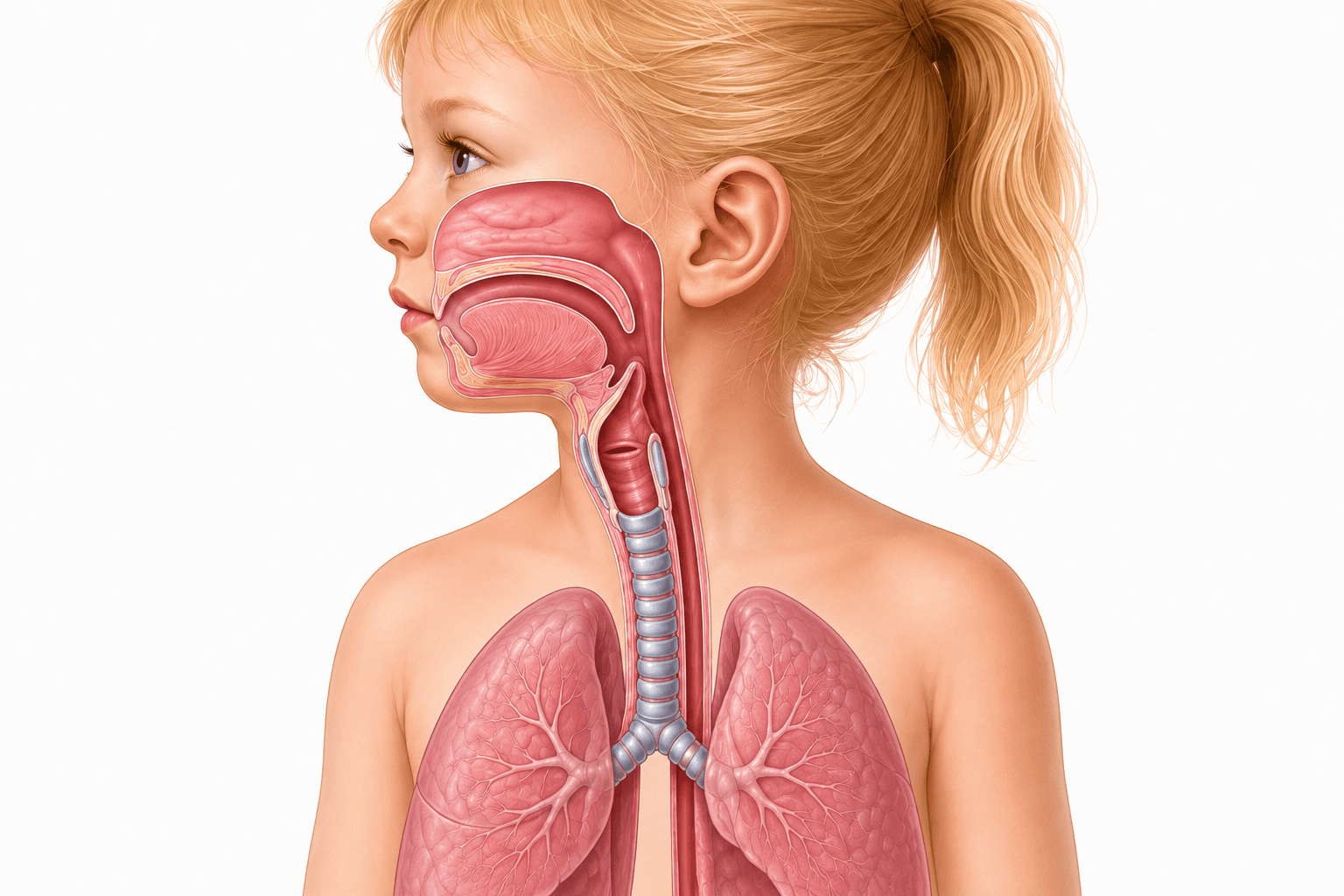
Larynx
Includes the epiglottis, supraglottis, vocal cords (glottis), and subglottis.
Subglottic airway
Region immediately below the vocal cords where narrowing is most clinically significant in croup.
Trachea
Conducting airway extending inferiorly from the larynx.
Subglottic airway
Normal vs croup
Normal
✓ Thin mucosa
✓ Wide airway lumen
✓ Minimal resistance to airflow
Croup
• Circumferential mucosal edema
• Markedly reduced airway radius
• Increased resistance and turbulent airflow
Why pediatric airways obstruct quickly
Small decreases in radius can cause large increases in airway resistance
The pediatric subglottic airway begins with a relatively small diameter. Circumferential edema therefore removes a disproportionately large fraction of the available lumen, increasing work of breathing and producing stridor.
Supraglottic airway
Structures above the vocal cords include the epiglottis, aryepiglottic folds, and surrounding pharyngeal tissues. Disease in this region is more likely to produce dysphagia, drooling, muffled voice, or difficulty handling secretions.
Glottic & subglottic airway
Croup predominantly involves the larynx and subglottic region immediately below the vocal cords. This localization explains the characteristic combination of barking cough, hoarseness, and inspiratory stridor.
Barking cough
Inflammation involving the larynx and proximal trachea produces the characteristic harsh, seal-like cough.
Hoarseness
Laryngeal inflammation affects phonation, producing a raspy or hoarse voice.
Inspiratory stridor
Narrowing of the extrathoracic upper airway generates turbulent airflow that is most prominent during inspiration.
Localization Check
Stridor is not wheezing
Stridor generally points toward obstruction of the upper or central airway. Wheezing usually reflects intrathoracic lower-airway narrowing. Substantial wheezing in a child presumed to have croup should prompt consideration of another or additional diagnosis.
Pathophysiology
Viral inflammation converts a small airway into a high-resistance airway
Follow the process from viral infection to the clinical findings heard at the bedside.
Viral infection
Parainfluenza viruses are classic causes, although influenza, RSV, human metapneumovirus, adenovirus, rhinovirus, and other respiratory viruses may produce the syndrome.
Mucosal inflammation
Viral infection spreads from the upper respiratory tract to the larynx and trachea, producing inflammation of the airway mucosa.
Subglottic edema
Circumferential mucosal edema narrows the already small pediatric subglottic lumen, creating the characteristic site of obstruction in croup.
Turbulent airflow
Increasing airflow velocity through the narrowed extrathoracic airway generates inspiratory stridor, retractions, and increased work of breathing.
Airway Physics
Why a few millimeters matter
Airway resistance is extremely sensitive to airway radius. Under laminar-flow conditions, Poiseuille's law predicts that resistance varies inversely with the fourth power of the radius:
R ∝ 1 / r⁴
This means that even a modest decrease in airway radius can produce a disproportionately large increase in resistance. Because young children begin with a relatively small subglottic airway, circumferential mucosal edema can rapidly consume a clinically important fraction of the available lumen.
Actual airflow through a narrowed croup airway may become turbulent, so Poiseuille's law is best used here as a conceptual model rather than an exact description of airflow during croup.
Why agitation matters
Crying can make the obstruction look dramatically worse
Crying and anxiety increase respiratory effort and airflow velocity through an already narrowed airway. This can worsen stridor and retractions. Whenever possible, evaluate the child while calm and allow them to remain in a caregiver's lap.
Natural history
Croup commonly begins with several hours to a few days of nonspecific upper-respiratory symptoms before the barking cough, hoarseness, and stridor become prominent. Symptoms are often worse at night and typically peak early in the illness. Most uncomplicated cases improve over several days.
History & Physical
Severity is determined at the bedside
The most useful examination asks whether obstruction is present only with agitation or persists while the child is calm.
Classic history
- • Age commonly 6 months to 3 years
- • Preceding rhinorrhea or other URI symptoms
- • Barking or brassy cough
- • Hoarse or raspy voice
- • Symptoms often worse at night
- • Fever may be present but is not required
- • Symptoms often worsen with crying or agitation
Physical examination
- • Inspiratory stridor
- • Suprasternal or intercostal retractions
- • Tachypnea and increased work of breathing
- • Hoarse cry or voice
- • Reduced air entry as obstruction worsens
- • Hypoxemia or cyanosis in severe disease
- • Altered mental status or fatigue as late warning signs
Clinical severity
Mild
- • Barking cough
- • Hoarseness
- • No stridor at rest
- • None or minimal retractions at rest
- • Stridor may appear with agitation
Moderate
- • Frequent barking cough
- • Easily audible stridor at rest
- • Visible retractions at rest
- • Child remains alert with adequate air entry
Severe / impending failure
- • Prominent or persistent stridor at rest
- • Severe retractions or respiratory distress
- • Decreased air entry
- • Fatigue or altered mental status
- • Cyanosis or hypoxemia
- • Stridor may become quieter as airflow falls
Do Not Miss
A quieter child is not always an improving child
In advanced upper-airway obstruction, stridor can become less prominent because the child can no longer generate adequate airflow. Decreasing air entry, exhaustion, cyanosis, or altered mental status are ominous findings even if the audible stridor seems softer.
Differential Diagnosis
What else could look like this?
Stridor is a localization clue, not a diagnosis. Features outside the classic croup pattern should prompt consideration of alternative causes of upper-airway obstruction.
Bacterial tracheitis
High fever, toxic appearance, rapidly progressive obstruction, thick or purulent secretions, or poor response to standard croup therapy.
Epiglottitis
Drooling, dysphagia, severe sore throat, muffled voice, tripod positioning, toxic appearance, and absence of the classic barking cough.
Foreign body
Abrupt onset, choking history, little or no viral prodrome, or persistent focal airway findings.
Anaphylaxis / angioedema
Sudden airway symptoms with urticaria, lip or tongue swelling, gastrointestinal symptoms, hypotension, or recent allergen exposure.
Diagnostic Red Flag
Toxic appearance is not typical uncomplicated croup
High fever, toxicity, rapidly progressive obstruction, purulent secretions, or poor response to appropriate croup therapy should prompt urgent reconsideration of the diagnosis, particularly bacterial tracheitis or another serious upper-airway process.
Diagnostic Workup
Typical croup is a clinical diagnosis
When the history and examination are classic, testing usually adds little and may agitate the child.
First principle
Do not test simply to prove croup
A child with the typical combination of barking cough, hoarseness, inspiratory stridor, and a compatible clinical course usually requires no laboratory testing or imaging to establish the diagnosis.
Usually unnecessary
- • Routine CBC
- • Routine inflammatory markers
- • Routine viral testing solely to diagnose croup
- • Routine chest radiography
- • Routine neck radiography
- • Routine laryngoscopy
Consider additional evaluation when...
- • Presentation is outside the usual age range
- • Symptoms are atypical or unusually prolonged
- • The child appears toxic
- • Disease progresses unexpectedly
- • Response to appropriate treatment is poor
- • A foreign body or deep-neck infection is suspected
- • Recurrent episodes suggest structural airway disease
Imaging Pearl
The steeple sign is supportive — not diagnostic
If an AP neck radiograph is obtained, it may demonstrate tapered subglottic narrowing known as the . The finding is supportive rather than diagnostic, and routine imaging is unnecessary when the clinical presentation is classic.
Clinical Safety
Avoid unnecessary agitation in significant upper-airway obstruction
Blood draws, imaging, IV placement, or forced examination can increase crying and respiratory effort. In a child with significant stridor, prioritize stabilization and obtain only studies that are likely to change immediate management.
Management
Treat the edema while keeping the child calm
Management is driven primarily by clinical severity rather than by laboratory or imaging findings.
Minimize agitation
Allow the child to remain with a caregiver, use a comfortable position, and avoid unnecessary procedures that increase crying and airflow demand.
Assess severity
Determine whether stridor occurs at rest, evaluate retractions and air entry, and look for fatigue, altered mental status, hypoxemia, or cyanosis.
Treat promptly
Give corticosteroid therapy for croup of any severity and add nebulized epinephrine when clinically significant stridor or respiratory distress is present.
Dexamethasone — first-line therapy
A single dose of dexamethasone is recommended for children with croup regardless of severity. Oral administration is generally preferred when tolerated, although intramuscular or intravenous administration may be used when necessary.
Common reference dose
Dexamethasone 0.6 mg/kg once.
Lower doses such as 0.15 mg/kg are used in some clinical pathways and may be similarly effective in many children, but evidence establishing equivalence across all severities is less certain. Follow local pediatric dosing guidance.
Nebulized epinephrine — rapid relief for moderate to severe disease
Nebulized epinephrine produces alpha-adrenergic vasoconstriction of upper-airway mucosa, rapidly decreasing edema. Its clinical effect begins quickly but is temporary, so it should be paired with corticosteroid therapy rather than used as definitive treatment alone.
Racemic epinephrine 2.25%
0.05 mL/kg nebulized
Maximum 0.5 mL
L-epinephrine 1 mg/mL (1:1,000)
0.5 mL/kg nebulized
Maximum 5 mL
Reassess after treatment. Repeat dosing may be necessary in persistent severe disease, with appropriate cardiorespiratory monitoring and escalation of care.
Why both?
Epinephrine buys time; dexamethasone provides sustained anti-inflammatory treatment
Epinephrine works rapidly but its effect wanes. Dexamethasone has a slower onset but provides more durable improvement. Children requiring epinephrine should therefore also receive corticosteroid therapy unless a specific contraindication exists.
Supportive care
- • Keep the child calm and with the caregiver
- • Encourage fluids if safely tolerated
- • Treat fever or discomfort when appropriate
- • Give supplemental oxygen for hypoxemia
- • Reassess respiratory effort and air entry frequently
Not routinely recommended
- • Antibiotics for uncomplicated viral croup
- • Albuterol unless separate bronchospasm is present
- • Cough suppressants or decongestants
- • Humidified mist as definitive therapy
- • Routine heliox for uncomplicated disease
Airway Emergency
Recognize impending respiratory failure
Progressive fatigue, altered mental status, cyanosis, hypoxemia, markedly decreased air entry, or worsening obstruction despite appropriate therapy should trigger immediate airway and critical-care escalation.
In severe upper-airway obstruction, involve experienced airway clinicians early. Avoid repeated nonessential interventions that agitate the child while definitive airway management is being prepared.
Disposition / Care Setting
Disposition depends on sustained improvement, not just the first response
The child should remain clinically stable after treatment before the care setting is de-escalated.
Discharge / outpatient care
- • No stridor at rest
- • Minimal or resolved retractions
- • Normal or near-normal air entry
- • Able to maintain hydration
- • No hypoxemia or concerning fatigue
- • Caregivers understand return precautions
Hospital admission
- • Persistent stridor at rest
- • Ongoing moderate respiratory distress
- • Repeated nebulized epinephrine requirement
- • Poor oral intake or dehydration
- • Inadequate or short-lived response to treatment
- • Concern about reliable observation at home
PICU / airway escalation
- • Severe or rapidly progressive obstruction
- • Markedly decreased air entry
- • Hypoxemia or cyanosis
- • Fatigue or altered mental status
- • Frequent epinephrine requirement
- • Concern for impending respiratory failure
After Epinephrine
Observe for sustained clinical stability
The improvement from nebulized epinephrine is temporary. Children should be observed after treatment — commonly for at least two hours — and should demonstrate sustained improvement without recurrent stridor at rest before discharge.
Institutional pathways may use somewhat different observation periods, so disposition should incorporate the clinical course and local protocol rather than a single clock-based threshold.
Recurrent or atypical croup
Repeated episodes, onset outside the usual age range, persistently severe symptoms, poor treatment response, or an unusual clinical course should prompt consideration of an underlying airway disorder and possible ENT, pulmonology, or aerodigestive evaluation.
Clinical Pearls
High-yield takeaways
These are the distinctions worth carrying from the page to the bedside.
Stridor at rest changes management
Give corticosteroids even for mild croup
Do not chase the steeple sign
Epinephrine does not replace dexamethasone
Toxic appearance should make you reconsider croup
Drooling is not a classic croup finding
Keep the child calm
Quiet stridor can be ominous
Bottom Line
Bark + hoarseness + stridor → localize first, then grade severity
Typical croup is diagnosed clinically. Give dexamethasone, add nebulized epinephrine when significant stridor or distress is present, minimize agitation, and reconsider the diagnosis when the child looks toxic or behaves unlike uncomplicated viral croup.
Knowledge Check
Apply what you learned
Work through each question in sequence. Select an answer, review the explanation, then continue.
Question 1
A 20-month-old develops rhinorrhea followed two days later by a barky cough and hoarse voice. He has inspiratory stridor only when crying and no stridor at rest. Which treatment is most appropriate?
Evidence Base
Clinical References
AAP Pediatric Care Online review covering epidemiology, upper-airway anatomy, clinical diagnosis, differential diagnosis, severity assessment, corticosteroid therapy, nebulized epinephrine, and disposition.
Evidence-based review addressing clinical diagnosis, differential diagnosis, Westley severity scoring, corticosteroid therapy, nebulized epinephrine dosing, observation, and outpatient management.
Contemporary AAP review of croup and epiglottitis including epidemiology, pathogenesis, differential diagnosis, and modern management principles.
Updated systematic review supporting glucocorticoid therapy for croup, including improvement in symptoms and reductions in hospital stay and return visits.
Secondary Educational Sources
The uploaded AAP Pediatric Care Online review and American Family Physician review served as core source material. The 2025 AAP Pediatrics in Review article and updated Cochrane glucocorticoid review were used for contemporary verification and evidence updates.
Educational Disclaimer
PediAtlas is intended for medical education and should not replace institutional guidelines, local protocols, patient-specific assessment, or clinical judgment.